
Introduction
In today’s competitive business environment, customers have more choices than ever before. A company may offer an excellent product or reliable service, but attracting attention and earning customer trust requires more than quality alone. Brand Development helps businesses create a recognizable identity, communicate their value clearly, and build meaningful connections with the people they want to reach.
A strong brand gives customers a reason to remember a company instead of treating it as just another option in the market. From the business name and visual identity to website content, communication style, customer experience, and online presence, every interaction contributes to brand perception.
For startups, small businesses, established companies, and organizations planning expansion, building a structured brand can provide a valuable foundation for marketing and long-term growth. Kalahamsa Infotech Pvt Ltd helps businesses strengthen their digital presence with practical solutions designed around their business objectives and target customers.
What Does Brand Development Mean?
Brand Development is the strategic process of creating, improving, and maintaining the identity and market perception of a business. It involves much more than designing a logo. It considers what a company represents, whom it serves, how it communicates, what makes it different, and how customers experience it.
A business with a well-defined identity can communicate more consistently across its website, social media accounts, advertisements, printed materials, search platforms, presentations, and customer interactions.
The objective is to make the business easier to recognize and understand. When customers repeatedly encounter a consistent message and experience, familiarity can grow into trust.
For example, a technology company may want to be perceived as innovative and dependable, while a local professional service may focus on reliability, personal attention, and expertise. The branding strategy should reflect those differences rather than applying the same formula to every company.
Why Businesses Need a Strong Brand
Customers often make decisions based on their overall impression of a company. Before contacting a business, they may visit its website, read reviews, check social media, compare competitors, and search for information online.
Brand Development gives businesses a structured way to influence this overall impression. A clear brand can help a company:
- Become easier for customers to recognize
- Differentiate itself from competitors
- Communicate its key advantages
- Present a more professional image
- Create consistency across marketing channels
- Strengthen customer confidence
- Support long-term customer loyalty
- Improve the effectiveness of marketing campaigns
A recognizable brand can also make communication easier. Instead of creating every marketing message from scratch, a company can work from established positioning, tone, visual standards, and core messages.
This consistency becomes especially valuable as a business grows and more employees, agencies, or marketing channels become involved.
Core Components of Brand Development
Brand Development Starts With a Clear Business Foundation
Successful Brand Development begins with understanding the business itself. Branding should represent the company’s real strengths rather than simply following temporary design trends.
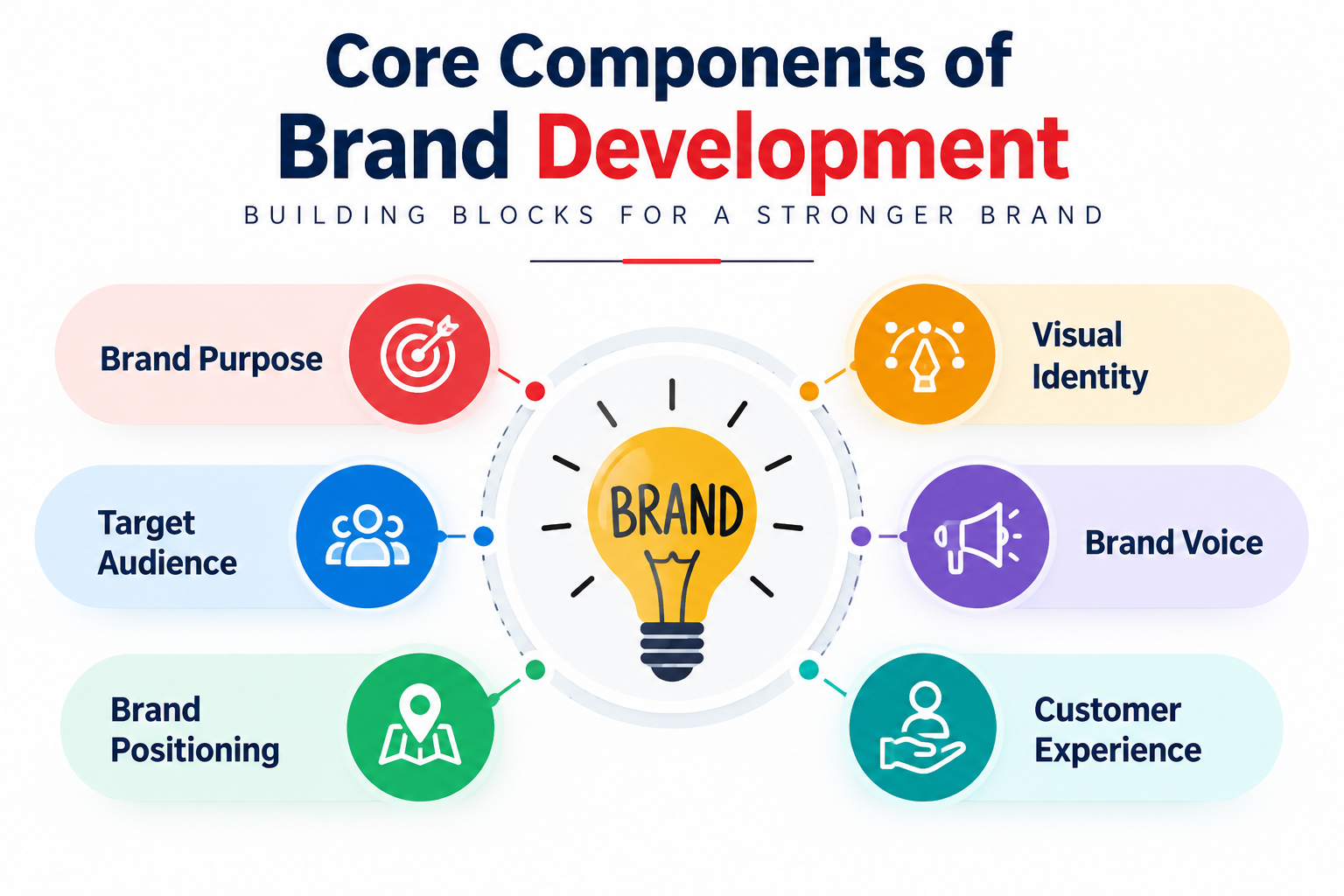
Several elements should work together to create a complete brand identity.
-
Brand Purpose
A brand needs a clear reason for existing. Its purpose explains the value it intends to create for customers and the broader direction of the business.
A strong purpose can guide decisions involving products, services, communication, customer experience, and marketing.
-
Target Audience
Not every customer has the same expectations. Understanding the target audience helps a company develop communication that feels relevant.
Businesses should consider customer needs, challenges, preferences, purchasing behavior, expectations, and the factors that influence their decisions.
For a local company, audience research may also include location, local competition, customer demographics, and regional search behavior.
-
Brand Positioning
Positioning determines how a business wants to stand apart from competing companies. A business may position itself around affordability, specialization, innovation, convenience, premium quality, expertise, speed, or customer service.
Effective positioning answers a simple question: why should customers choose this business instead of another?
-
Visual Identity
Visual identity includes the logo, typography, colors, imagery, icons, graphic elements, and layout styles used by a company.
These elements should be consistent and adaptable. A visual identity that looks good on a desktop website should also work on mobile screens, social media profiles, advertisements, business documents, and other formats.
-
Brand Voice
Every business has a personality. Some brands communicate in a formal and authoritative manner, while others use a friendly, conversational, or energetic style.
A defined voice helps ensure that website content, social media posts, advertisements, emails, and customer communication feel like they come from the same organization.
-
Customer Experience
Brand perception is created through actual experiences, not just advertising.
Website usability, enquiry handling, service delivery, response times, support, follow-up, and professionalism all influence how customers perceive a business.
A company that promises excellent service must make sure the actual experience supports that promise.
How to Create an Effective Brand Strategy
A successful Brand Development process should be practical, measurable, and connected to business goals. The following approach can help companies create a stronger identity.
Step 1: Research the Current Market
Before making changes, understand the existing market. Study competitors, customer expectations, industry trends, online visibility, reviews, and existing brand communication.
This research can reveal opportunities that competitors are not addressing effectively.
Step 2: Define the Ideal Customer
Create a clear picture of the people most likely to purchase from the business.
Instead of trying to communicate with everyone, identify the audience that has the strongest need for the company’s products or services.
Understanding this audience can improve website copy, advertising messages, content marketing, and social media communication.
Step 3: Identify the Competitive Advantage
Every business needs a reason to be remembered.
The advantage could be specialized knowledge, faster service, better support, local expertise, technology, convenience, quality, pricing, or a unique approach.
The goal is to identify genuine strengths and communicate them clearly.
Step 4: Develop the Brand Message
The central message should explain what the company does, who it helps, and why customers should consider it.
Supporting messages can then be developed for individual services, products, campaigns, website pages, and advertisements.
Clear messaging reduces confusion and allows potential customers to understand the business quickly.
Step 5: Build the Visual System
Once the strategic foundation is established, create the visual identity.
The logo, colors, fonts, photography, graphics, and layouts should work together rather than appearing as separate design choices.
A brand style guide can help employees and marketing partners maintain consistency.
Step 6: Apply the Strategy Across Digital Channels
The website should reflect the same positioning and visual identity used elsewhere.
Social media profiles, business listings, advertisements, email campaigns, presentations, and other customer-facing platforms should also maintain consistent information.
This creates a smoother experience when customers move from one channel to another.
Digital Marketing and Brand Building
Modern branding cannot be separated from digital marketing. Customers increasingly discover businesses through search engines, social platforms, online directories, advertisements, and recommendations.
Brand Development and SEO can work together when businesses create useful content around the topics their customers actually search for.
A company website should contain clear service pages, informative articles, trustworthy business information, strong calls to action, and content that addresses customer questions.
Search engine optimization can increase visibility for relevant searches, while consistent branding helps visitors recognize the business once they arrive on the website.
Social media provides another opportunity to reinforce the brand. Businesses can share educational content, company updates, customer stories, industry insights, visual content, and useful tips while maintaining a consistent communication style.
Local businesses should also pay attention to their online business information. Accurate names, contact details, services, operating information, and location data can make it easier for potential customers to discover and evaluate the company.
Brand Development for Startups
For a new business, Brand Development can establish a professional foundation before marketing activities become complicated.
Startups should begin by understanding their target market and identifying a clear value proposition. A simple but distinctive identity is usually more effective than an overly complicated branding system.
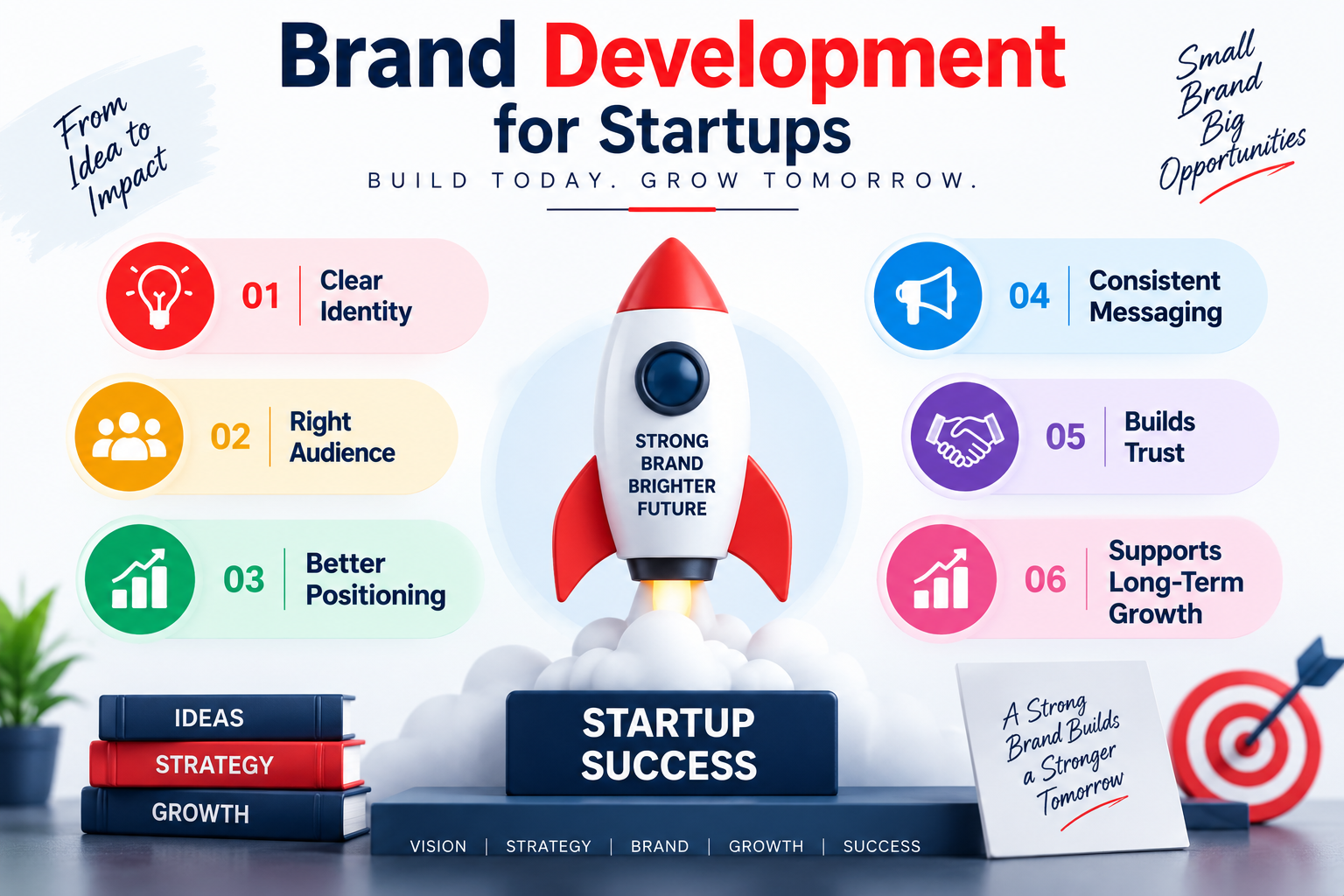
A startup should also think beyond the launch. Its identity needs enough flexibility to accommodate future products, services, locations, and customer segments.
Consistency is particularly important for new companies because customers need repeated exposure before a business becomes familiar.
Brand Development for Growing Companies
As a business expands, its branding requirements often become more complex. New employees may join the organization, new services may be introduced, and the company may enter additional markets.
A structured Brand Development strategy helps maintain consistency during this growth.
Businesses should periodically review their website, marketing materials, social profiles, advertisements, customer communication, and other brand assets.
If different departments are communicating completely different messages, customers may receive a confusing impression. Brand guidelines can reduce this problem by giving everyone a common framework.
Common Branding Mistakes Businesses Should Avoid
A good branding strategy can be weakened by avoidable mistakes.
Changing the identity too frequently: Constant redesigns can prevent customers from developing recognition.
Focusing only on appearance: Attractive visuals are valuable, but they cannot replace strategy and meaningful customer communication.
Copying competitors: A similar identity can make a company look interchangeable. Businesses should identify authentic points of differentiation.
Using inconsistent messages: Different promises across marketing channels can create confusion.
Ignoring customer feedback: Customer opinions can reveal gaps between intended brand perception and actual experience.
Neglecting the website: A company’s website is often one of the first places potential customers investigate the business.
Overusing trends: A brand should remain current without sacrificing clarity and long-term recognizability.
Measuring Brand Performance
Effective Brand Development should have measurable objectives. While brand perception can sometimes be difficult to quantify directly, businesses can track several useful indicators.
These may include branded search impressions, website traffic, direct visits, social engagement, customer enquiries, conversion rates, repeat customers, review activity, referral traffic, and customer feedback.
Businesses can also conduct surveys or informal customer interviews to understand whether people recognize the company and understand its main value proposition.
The most important measurement depends on the company’s objective. A startup may focus on awareness, while an established company may focus on reputation, customer loyalty, market expansion, or increased enquiries.
Regular evaluation helps businesses identify which activities are producing useful results and where adjustments are necessary.
Why Choose Kalahamsa Infotech Pvt Ltd?
Kalahamsa Infotech Pvt Ltd provides digital solutions for businesses seeking to establish a stronger and more professional online presence. A successful Brand Development strategy should connect creative identity with practical business objectives.
The right approach should not stop with a logo or a single marketing campaign. It should consider how customers discover the company, what they see when they visit its website, how information is communicated, and whether the overall experience feels consistent.
For businesses in Bangalore and other markets, a coordinated digital presence can support visibility, credibility, customer engagement, and long-term growth.
Kalahamsa Infotech Pvt Ltd can work with businesses that want to strengthen their digital identity and create a more organized approach to online communication.
Building a Brand That Can Grow With Your Business
Long-term Brand Development requires consistency combined with the ability to adapt.
Markets change, customer expectations evolve, and businesses introduce new products or services. A strong brand should be able to respond to these changes without losing its central identity.
The best approach is to protect the elements that customers recognize while updating areas that need improvement.
For example, a company may retain its core logo and positioning while improving its website, content strategy, photography, social media approach, or customer communication.
This balance allows the brand to remain familiar while continuing to feel relevant.
Conclusion
Brand Development is a strategic investment in how a business is understood, remembered, and trusted. It brings together positioning, audience understanding, visual identity, messaging, digital presence, and customer experience to create a cohesive business identity.
A strong brand does not happen overnight. It develops through clear strategy, consistent communication, useful customer experiences, and continuous improvement.
For startups, local businesses, and established companies, building a recognizable identity can provide a stronger foundation for marketing and future expansion. With the right strategy and digital execution, businesses can move beyond simply being visible and work toward becoming memorable.
Kalahamsa Infotech Pvt Ltd can help businesses strengthen their digital presence and create a professional foundation for sustainable growth.

Contact Kalahamsa Infotech Pvt Ltd
Kalahamsa Infotech Pvt Ltd
KIPL, Ground Floor, 26, 18th Main Rd, CHBS Layout, Stage 2, Vijayanagar, Bengaluru, Karnataka 560040
Phone: +91-7892976086
Email: kalahamsainfotech@gmail.com
Website: www.kalahamsa.in
Beyond branding, KIPL assists with: